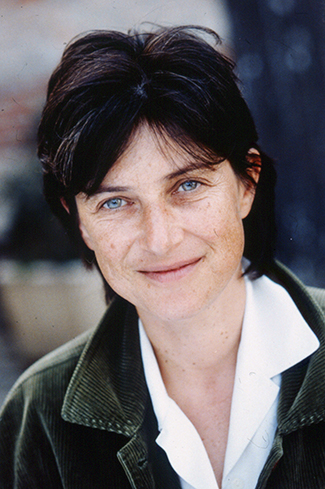
Photo by Marthe Lemelle, courtesy Marian Goodman Gallery
"Comparable in force and originality to Godard or Fassbinder, Chantal Akerman is arguably the most important European director of her generation." —J. Hoberman, The Village Voice
"Akerman the filmmaker came of age at the same time as the new age of feminism, and [her films] became key texts in the nascent field of feminist film theory. Feminism posed the apparently simple question of who speaks when a woman in film speaks (as character, as director ...); Akerman insisted convincingly that her films' modes of address rather than their stories alone are the locus of their feminist perspective. The many arguments about what form a 'new women's cinema' should take revolved around a presumed dichotomy between so-called realist (meaning accessible) and avant-garde (meaning elitist) work; Akerman's films rendered such distinctions irrelevant and illustrated the reductiveness of the categories." —Janet Bergstrom, Sight and Sound
|
"The films of Chantal Akerman are the single most important and coherent body of work by a woman director in the history of the cinema." —Film Center Gazette of the School of the Art Institute "Chantal Akerman spoke to each of us, intimately, as if we were the only one in the room when she was talking to us, the only one in front of the projected image when we are in the theatre or the museum/gallery space where her installations are exhibited. [This] this is a cinema that burns in us, that lives in us, a cinema that we have inherited, a cinema that will continue through us. We are her orphans, but also her heirs." — Senses of Cinema
Born in Brussels, Belgium, in 1950, Chantal Akerman was a filmmaker whose work gave new meaning to the term "independent film." An Akerman film is an exercise in pure independence, creativity and art. Her viewers must give themselves over completely to the experience of her films and watch with open minds. Strong themes in her films include women at work and at home, women's relationships to men, women, and children, food, love, sex, romance, art and storytelling. Each Akerman film is a world to be explored on its own terms. Her films are the subject of numerous books including Identity and Memory: The Films of Chantal Akerman by Gwendolyn Audrey Foster and Nothing Happens: Chantal Akerman's Hyperrealist Everday by Ivone Margulies. Chantal Akerman died in Paris, France, in 2015, having forever changed the history of cinema.
Icarus Films is proud to distribute seven films (and a 5-disc box set!) by Chantal Akerman:
No Home Movie - In her essential final feature, Chantal Akerman documents her relationship with her mother, a Holocaust-survivor. Almayer's Folly - Narrative film adaptation of Joseph Conrad's first novel, following a European man living in Southeast Asia and his half-indigenous daughter. Down There - Chantal Akerman spends a brief period on her own in an apartment by the sea in Tel Aviv, contemplating her family, her Jewish identity and her childhood.
|
One Day Pina Asked - Chantal Akerman follows choreographer Pina Bausch and her dance company on a five-week tour across Europe. From the East - Chantal Akerman retraces a journey from the end of summer to deepest winter, from East Germany, across Poland and the Baltics, to Moscow. South - The heart of this journey is the brutal murder of James Byrd, Jr in Jasper, Texas. But this is not an anatomy of his murder, rather, it is an evocation of how this event fits in to a landscape and climate as much mental as physical. From the Other Side - With technology developed for the military, the INS has stemmed the flow of illegal immigration in San Diego. But for the desperate, there are still the dangerous deserts of Arizona, where renowned filmmaker Chantal Akerman shifts her focus. Chantal Akerman Four Films - Four documentaries spanning two decades are included in this 5-disc box set, with a 16-page booklet and bonus film about the late filmmaker.
Related Films:
Related Links:
Featured Filmmaker Index
The Director's Director: Chantal Akerman
|


 Cart
Cart


